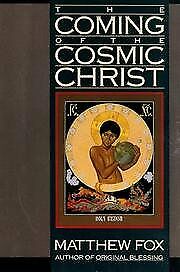
the healing of mother earth and the birth of a global renaissance
©1988 by Matthew Fox
Published by: HarperCollins, 278 pp.
tying it all together
When I encountered this book in the late 80s, I knew that God was leading me to a different kind of faith than I had encountered in my churches. I had read several other books which began pointing me into this wonderful direction of the Wild Things of God. Walking on Water, by Madeleine L’Engle, was the book that let me know that there was a more holistic, deeper way of being Christian, The Mustard Seed Conspiracy by Tom Sine showed me that it was something which involved action and justice, and Richard Foster’s The Celebration of Discipline revealed that it had been growing throughout Church history. But this one tied it all together, and gave a name to the thing which had been tugging at my soul for several years: mysticism.
When I say this book “ties it all together,” I’m making an understatement. It’s almost easier to describe what The Coming of the Cosmic Christ is not about, for Fox relates this cosmic Christian perspective to everything. Fox, a Dominican Catholic priest at the time of its writing (now Episcopalian), became uniquely prepared to write this book through his previous works. His earlier books ranged from his translations and commentaries on the wild mysticism of Meister Eckhart (Passion for Creation) and St. Thomas Aquinas (Sheer Joy) to his revelation of compassion as the central theme of Biblical Christianity (A Spirituality Named Compassion), and his treatment of the four essential paths of Christian mysticism in Original Blessing. Passion for Creation (originally titled Breakthrough) was called “the most important book on mysticism in 500 years,” by one writer, and few who have read this groundbreaking work would quickly disagree. Yet The Coming of the Cosmic Christ is the one almost certainly to be remembered as his masterpiece.
the death of compassion
Fox divides the book into five sections, beginning with a vivid image which came to him in a dream: “Your mother is dying.” Using this image, he examines how Compassion is dying as seen by all contemporary crises throughout the world: Mother Earth is dying, hope is dying, the youth are dying, and native peoples, cultures, religions, and wisdom are dying. The news is sobering. Fox pulls no punches on summarizing the world-wide extent of social decay, environmental destruction, political oppression, the devastating tolls of wars and million-dollar-a-minute military spending, religious intolerance, and increasing despair. However, he reminds us that although compassion may be dying, it is not dead! There is still hope, and it is ours to bring to the world.
the answer of authentic mysticism
In the second section he examines what mysticism is, and what it isn’t. Fox shows mysticism as something cosmological, showing the place of the person within all creation, and believes that when true cosmology, true awareness of one’s place in the Universe is absent, persons and cultures will often substitute “pseudo-mysticisms” to fill the void, such as fundamentalisms (of any religion or ideology), militarism, alcoholism, and the brain-numbing worship of popular celebrities. He further shows how Jesus embodies all the characteristics of a true mystic, and is the founder of Christian mysticism.
The third section, titled “The Quest for the Cosmic Christ,” is an inspirational survey of the mystical tradition from the Bible, through Christ and the apostles, through the Church Fathers, the medieval mystics, up to modern-day mystics. This “Cosmic Christ” is not “another Christ,” but simply the living Christ, the compassionate Word, rooted in Jesus, and living today.
The fourth section shows the suffering of Christ continuing in the suffering of the poor, the victims of war and greed, and the sufferings of Mother Earth. They too are Christ, since Christ is the One “in whom all things hold together,” and Jesus identifies himself with “the least of these” on earth.
a vision of the second coming
The fifth and final section is by far the longest. Titled “A Vision of the Second Coming: The Healing of Mother Earth and the Birth of a Global Renaissance,” this is a manifesto of social mysticism. Fox believes that true mysticism is not, and cannot be, a private affair. It is by nature redemptive, as Christ is, and so we must become Christ, enacting the resurrection of the living Cosmic Christ in our beings and then our actions, to transform society and bring healing to all its suffering, broken parts through love, imagination, peacemaking, and environmental, moral, and social justice. Fox shows, with conviction and enthusiasm, how restoring the mystical mind of compassion (the Christian work of love) can bring a global renaissance to the entire world, including every aspect of society, from religion to sexuality, from peace-making and disarmament to mentoring the young. Remaking the world will require unparalleled creativity. Fox says: “The living cosmology ushered in by the Cosmic Christ will do more than redeem creativity itself; it will propose creativity as a moral virtue—indeed as the most important moral virtue of the upcoming civilization“. Fox urges us to begin a great work, the same great work that Jesus challenged us to 2000 years ago: to live and build the divine Kingdom.
This book is almost certainly the most comprehensive on what a modern mystical Christian worldview can be, and one of the most comprehensive books I’ve seen on anything, period. There are plenty of books on the trends of evil in this world system, plenty of calls for peacemaking, plenty of appeals for spiritual renewal, but Cosmic Christ addresses all these issues and more, with information, insight, and inspiration.
That said, this really isn’t an introduction to the mystical path. For one thing, it’s not an introductory book, but a scholarly examination (with hundreds of footnotes) of the need for a radical change through the world. Secondly, Fox never discusses the personal entrance into the mystic adventure. Too often, he makes it sound like mysticism is another world-view, rather than the transformative encounter with divine Reality. He never mentions meditation or contemplation, and he is quite vague on how exactly to be changed in order to change the world. But this is a different kind of mystical writing: shouting like a prophet for us to embrace a social, global mysticism through action and love. Fox’s courage and genius in proclaiming the urgency of following Jesus’ teachings and building his Kingdom of compassion is beyond inspirational. Simply put, this book changed my life.

 A strictly impersonal metaphor, such as the Tao, could be “It”. . . but even capitalized, “It” seems too impersonal. The Sanskrit word Tat (That) seems much better, since “that” can be personal or impersonal. Early